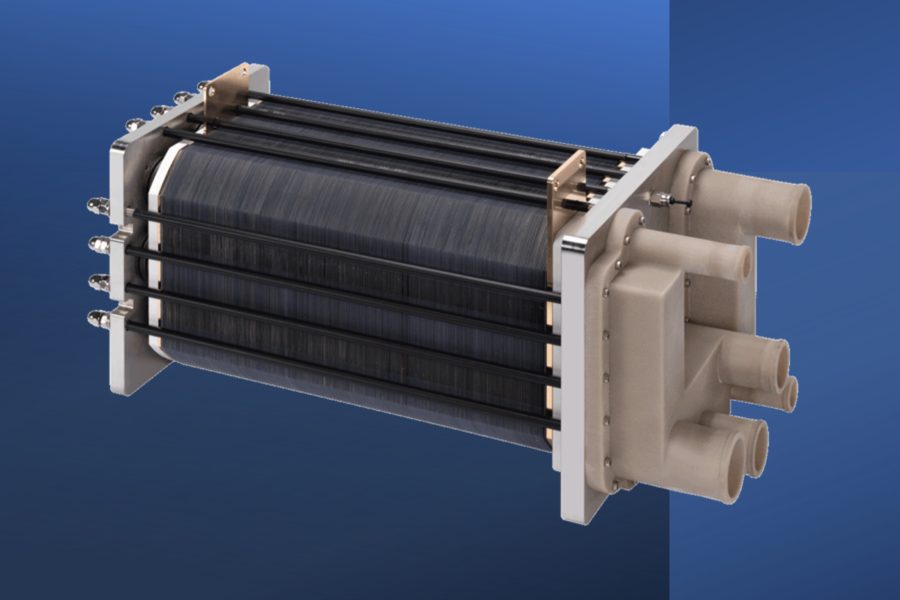
The certification validates the stack’s safety architecture and manufacturing consistency, allowing OEMs and system integrators to reuse component-level safety evidence and reduce downstream certification effort.
The milestone builds on previously announced third-party testing results, in which independent verification by TÜV Rheinland confirmed record-setting power density figures for the G-100 stack. During that testing, the stack achieved up to 9.77 kW/L volumetric power density and up to 9.7 kW/kg gravimetric power density, establishing a benchmark for size and weight performance in hydrogen fuel cell stacks.
Siltrax stated that the certified G-100 platform translates these performance results into production-ready hardware designed for real-world duty cycles. The stack is based on the company’s proprietary silicon-based bipolar plate architecture, which is intended to address thermal management, mechanical durability, and weight constraints in applications such as aviation, heavy transport, and distributed energy systems.
The company noted that the record-setting test results were achieved using commercially available components in addition to its proprietary bipolar plates and flow channel design, indicating further performance potential as optimized gas diffusion layers and membranes are integrated.
“The TÜV certification is a critical business enabler,” said Dr. Zhengrong Shi, Chief Executive Officer of Siltrax. “We aren’t just building a more efficient fuel cell – we are providing a certified, safe and repeatable hardware platform. This allows our partners to bypass regulatory uncertainty and move straight to commercial application with full confidence in the product’s reliability.”
Siltrax is now offering G-100 evaluation units to qualified OEMs as it scales manufacturing for deployment across aviation, heavy transport, and distributed energy applications.